

The Fire Indoors: What Heat Asks of Women in Jacobabad, Jaffarabad and Badin
As summers in Sindh and Balochistan grow hotter, the burden falls hardest on the women who cook, carry and keep watch over children through sleepless nights. I travelled through many districts to hear these stories, and move forward here with three.
By Syeda Kashmala
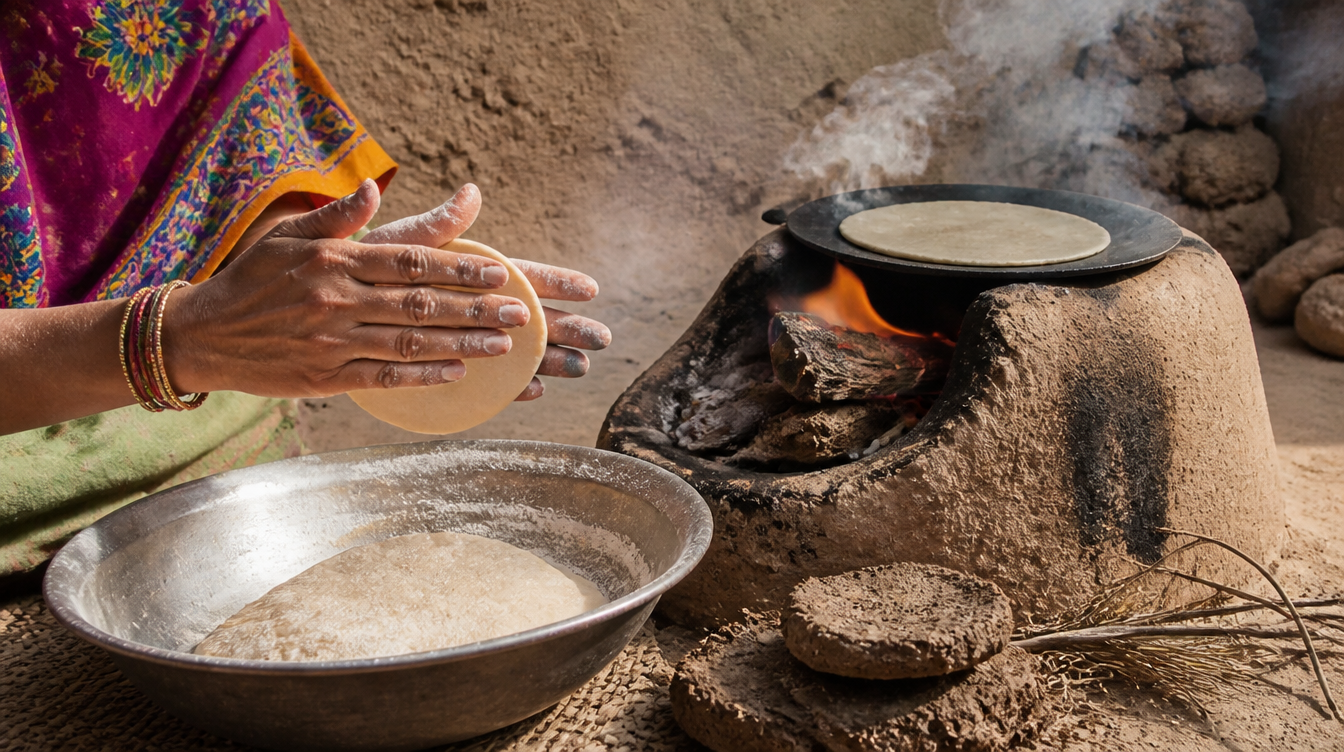
The chula sits at the back of the house. It provides a bit of shade and, more importantly, saves the rest of the house from its heat: a mound of clay shaped by hand and blackened by years of fire. Hajira kneels in front of it at noon, slapping dough between her palms, ready to place it on the stove.
I asked if I could sit beside her for a while and make one roti with her. I wanted to know, in my own body, what she does every day.
I lasted a few minutes. The heat came off the clay in waves, and the smoke from the dung cakes and dry twigs rolled straight into my face. My eyes streamed. My throat closed. I tried to finish that roti because I didn’t want to leave her alone, but I moved back, then back again, and finally stood up and walked to the edge of the courtyard, where the air was merely hot rather than unbearable.
I did the best I could, but she didn’t stop. She turned the rotis, pulled them out, stacked them in a cloth, and reached for the next ball of dough. When I apologised, she laughed and said I had made a “VIP” roti. What she said stayed with me through every village I visited afterwards, and it will stay with me forever.
Getting used to it is the work women in these districts are expected to do, and nobody counts it.
Would heat take breaks?
Jacobabad has become a byword for extreme heat within Pakistan and beyond, with temperatures above 50°C now a familiar feature of May and June every year. Across the provincial border, Jaffarabad in Balochistan sits on the same scorched plain, living a reality not far from Jacobabad’s. Then there is Badin, which faces the heat alongside a creeping sea that has salted its fields and pushed families off land they lived on for generations.
Climate reporting from these places usually speaks in averages: degrees, crop losses, hospital admissions. It leaves out the people living these realities, especially women. It rarely captures how a hot day is divided up inside a household, and who is left holding the hardest part of it.
Men in these areas often work outdoors, in fields, on construction sites and in fishing, and their exposure is real and dangerous; there is no denying that. But women’s exposure happens in places that never make it into heat action plans: beside the chula, inside airless rooms with sick children, on the path to collect firewood. It is labour that has no shift timings and no breaks.
“You can’t leave your husband hungry”
In a village outside Jacobabad, I asked a woman in her forties a simple question. Had she changed the time she cooks lunch, now that midday has become so dangerous? Could she cook earlier, in the cooler hours, and keep the food aside?
She looked at me as if I had misunderstood something basic. “No,” she said. “You can’t leave your husband hungry. You have to prepare the food.”
Lunch, in her home, means fresh rotis when the men come back from the fields, and that means standing at the fire at exactly the hottest hour of the day. Public health advice tells people to stay indoors and avoid exertion between noon and four. For her, that advice simply doesn’t apply. The expectation of fresh, hot food served on time carries more weight in her household than any warning from the meteorological department.
Days and nights of no sleep
In Jaffarabad, I met a young mother holding a baby who would not settle. She told me she had barely slept for days. The children cry through the night because the rooms are too hot, and in the daytime the heat is worse, so they cannot sleep then either. In her exact words: “Baji, humare liye to raat din aik jaisa hai” (“Sister, for us, night and day are the same”).
What she described is a form of care work that climate policy has almost no language for. When temperatures stay high after dark, mothers become the cooling system, and these mothers are sometimes children themselves. They fan children by hand for hours. They wet cloths and lay them on small foreheads. They wake every time a child stirs, then rise at dawn to start the day’s cooking, washing and water collection with no rest at all.
Infants and young children are among the most vulnerable to heatstroke and dehydration, and it is mothers who stand between them and that danger, night after night, with nothing but a hand fan and a bucket of water.
Exhaustion of this kind accumulates. A woman who hasn’t slept properly in a week is still expected to manage the household as if she had. Nobody asks how she is coping, because her coping is assumed.
Firewood, carried while pregnant
In Badin, a woman who was several months pregnant told me there is no electricity in her home. Without power there is no fan, no way to cool water, and no alternative to the open fire for cooking. So she still walks to gather firewood, in the heat, with the weight of her pregnancy.
“Kaam to karna hai na madam. Bacha to Allah ki den hai. Pait se ho to baqi bachon ko kaun khilaye ga?” (“The work has to be done, madam. A child is God’s gift. If I stop because I’m pregnant, who will feed my other children?”) she said, holding her two-year-old.

The risks of heat during pregnancy are well documented, including dehydration, exhaustion and complications for both mother and child. Yet for her, the question of whether to go is already settled. If she doesn’t collect the wood, there is no fire, and if there is no fire, there is no food.
Energy poverty here isn’t a line in a development report. It is a pregnant woman bent under a bundle of branches at the hottest hour of the afternoon.
Will the gendered labour of Pakistani women ever be counted?
Around the world, reporters and researchers are finally beginning to document how extreme heat is gendered: garment and salt-pan workers in India describing miscarriages and skipped meals, or women in parts of Africa who must walk farther for water as sources dry up. The women of Jacobabad, Jaffarabad and Badin belong in that record.
Their experiences point to the same conclusion. Heat doesn’t fall evenly on a household. It follows the division of labour, and the division of labour follows women into the kitchen, the sick room and the fields where firewood grows.
Pakistan’s heat responses are slow and need to be more effective, especially at the government level. They still focus on hospitals, water points and public messaging, and these matter, undoubtedly. But a warning to stay indoors means little to a woman whose kitchen is an open fire, and a cooling centre in the city means nothing to a mother in a village without electricity.
Can individual efforts change these realities? What would clean cooking fuel, reliable power for the poorest households, shaded and ventilated kitchens, and care support for mothers of young children look like? Would they reach women where the heat actually reaches them?
Before I left the courtyard in Jacobabad, Hajira handed me a roti wrapped in cloth, still warm from the chula I couldn’t sit beside for more than a few minutes. She would be back at it the next day, and the day after that, at noon.
Syeda Kashmala is a storyteller and lawyer.
Related Stories

 Marriage age fixed at 18 years in Punjab: New law passedApril 15, 2026